Wednesday, 24 July 2024

More Inspiration

 The following  pictures were taken during my last "trip" to the Esch/Belval site. While this is a new building and hasn't really anything to do with the steel industry (though in the same area) I was fascinated by the different apertures and the torn plastic sheets which all show different shapes and textures.                              


I love this picture because of its composition, which was a deliberate choice, the mixture of old and new, the squares and the curved yellow shape as well as the bright green plants in the foreground


TEXTILE STUDY GROUP WITH JANE MCKEATING

 This year's theme for the Summer School was "Travelling Lines", the travel could be going downstairs to the kitchen to have a cup of coffee, the garden, a real travel or even an imaginary one.

I saw this as an opportunity to get back into the theme had I chosen for the Diploma and shortly before leaving for the UK went back to the nearby industrial site to eventually draw, take pictures and get re-inspired.

The class started with a quick but efficient exercise where we were asked to go out and make 20 sketches in 20 minutes on Post-it papers. We had to choose a maximum of 3 different mediums. Unfortunately it was still raining, we had to be quick and concentrate on the essential. Then we had the same exercise (less sketches) on our chosen theme relying on our memory.

We then had to choose three words out of those written down by our neighbour and do collages either with paper or fabric or both of them. Again this exercise had to be done rather quickly.

I wanted to render an urban feel, the decay and geometric shapes of Esch/Belval. This was an exercise I really enjoyed. I had taken some of my painted papers with me and knew in which direction I wanted to go. The limited amount of time was good as you didn't get tempted to overdo a piece.

All the time Jane showed us some of her work to explain what she wanted us to do and what the possibilities were. We were talking about thread, the colour of it, the amount of stitching, edges, we did some monoprinting (something I loved).

I soon realized that I wanted to start stitching on fabric, I was longing for some fabric in my hands. So the last day and a half I spent on the stitching.

Jane took the time to mentor each of the students separately. She didn't use the time that was supposed to be her free time. In this tutorial we took a look at my Diploma sketchbook and some of my photos. We discussed why it was important to sketch instead of taking just pictures with the cell phone. (I was so motivated that I sketched while waiting for boarding at the airport :) 

I told Jane that I'd like to introduce more figurative elements at least in this body of work, maybe with monoprinting, who knows. I also realized how much I missed hand stitching (which I did then on my trip back to Luxembourg) as well as working with concrete imagery. I was very much attracted by the loose paints in Jane's work and I was mesmerized by the amount of her stitching.

The following pictures show the collaged work as well as the work in progress which I started in fabric.


Wednesday, 10 July 2024

Sculptural work


Details


All of the three pieces were done with a rope basketry technique. As far as possible the pieces were done on the sewing machine, the shaping happened through the positioning of the piece, holding it for instance more upright. The different elements were sewn together by hand. I started with an idea in mind but then had to go with the flow and let the piece develop for itself. 
 I deliberately chose to not work in color, having discovered my love for black an white in one of the Distant Stitch Modules. I wanted the shapes to speak for themselves but due to the stopping and restarting when replacing the black thread there is some variation in tone.
I think my main influence for doing this work comes from the times when I had pottery classes. This technique remind me of the work on the potter's wheel. The link to the natural world is obvious, the love for harmonious shapes continues to influence me.
It was interesting to hear what people had to say about my work and what they saw in it. 
The material used is a cream coloured 3mm macramé thread and regular black thread.

This is what I do in the evening when I'm tired but still have to do something with my hands.
This is all hand work, also a basketry technique using linen rope and 0,9 mm linen thread


Sunday, 11 February 2024

Stage 4 - Cut up into separate shapes

Test weaving

 This is a little test weaving where I tried to reproduce a richly textured surface reflecting the feel of an old and weathered industrial site. I used hatching to blend some colours but also did some needle punching and hand embroidery in some areas to introduce more textures. 


In the following samples I used paper as I didn't want to waste my precious fabric samples.

In order to reproduce the colours and textures more accurately, I took a picture of the fabric samples which I printed out on a A4 sheet of paper.


Sample 1


Sample 2


Sample 3


I decided that my initial shape didn't have enough potential and flexibility to develop further so I did some changes to it . The final shape allows more room for intertwining 


Sample 4

For more contrast the shapes were put onto a plain coloured background


Sample 5


Sample 6


No I have to make up my mind when it comes to the sewing and which sample to choose.


Before cutting out the shapes  outlined them first with cable stitch. This allows the fabric not to fall apart.

I opted for  a blue colour for the shape and for a beige colour for the curved lines with an ocre upper thread.
The shapes were traced on the back before being stitched and cut out.
The shape was mirrored .

Before the actual sewing I played around with them as I had an idea in mind and wanted to see what it would look like.

Some ideas before the sewing: shapes put onto the neutral background. They are not fixed yet but I like the way they ondulate, it looks more interesting than if they laid flat.


-------------------------------

I was very much attracted by the shape of the blast furnace which is the landmark of the Belval industrial site. It looks very majestic a bit like a fortress. 


I know it is a very simple (vase) shape but I like the idea of having this kind of "canvas" .
They are just some basic ideas which are difficult to get out of my head once they have settled in there:( 

Hereafter are some ideas where I played loosely with the shapes, pinning them onto some felted fabric wrapped around a piece of EVA foam.

The size of the pipe is not wright, it needs to be bigger.

Here the curved stripe was wrapped around the tube with the shapes intertwined, This is actually the sample I prefer as it relates to the idea of the conveyor belt where the finished items are transported. 
 
In the following example the shapes are put in an unorganized way onto the tube 


Monday, 4 December 2023

Diploma - Chapter 12 - Towards an Embroidered Item - Choose background-Colour background-Add detail and pattern with stitching

 For this exercise I chose a neutral coloured coton in a grey/brown tone, knowing that, at least for the first fabric I would cover most of it.

This background fabric was then covered with Bondaweb which I pealed off before layering it with different fabrics and threads.

Fabric  1


Here the background got covered with different fabrics in a stripy pattern, knowing that the surface would be cut up and that this pattern would "disappear".

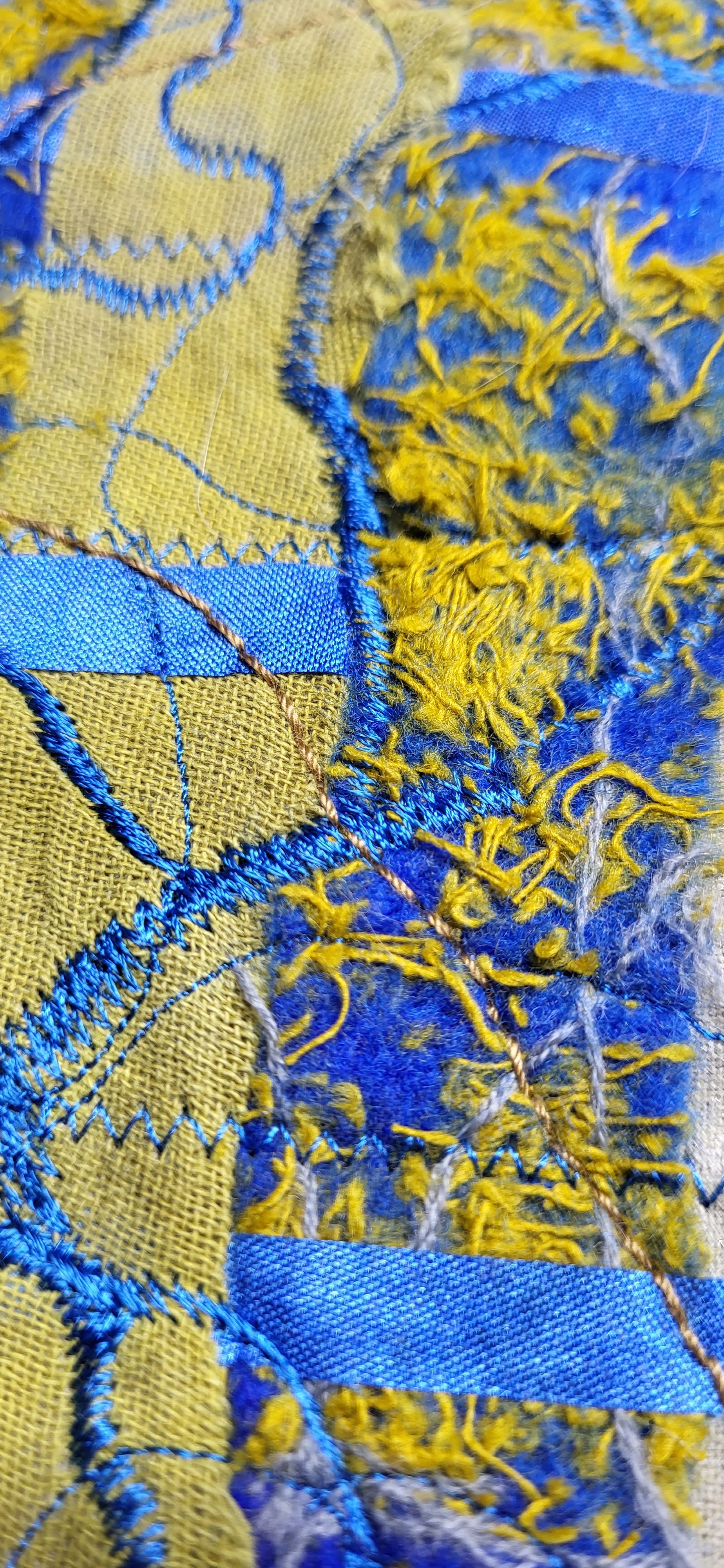
The main focus definitely lies here on the blue stripe which consists of a prefelt with dry  snippets of mustardy macramée threads from another project, felted in with the embellisher from both sides

The other stripes consist of fabrics in different tones of yellow or beige. The stripes were then fixed onto the background with a hot iron. 

Stitching was added with free machine zigzag in blue in a pattern inspired by one of the shapes from the previous chapters, more straight machine stitching was added in blue and yellow as well as a "normal" zigzag stitch in a horizontal grid.


Fabric 2


For this second fabric different snippets of fabrics were layered in a random way. They consist of a beige sheer silk, scrim, grey and light brown coton, acrylic painted yellow fabric, grey painted bondaweb as well as loosely layered threads in grey and yellow. The whole background was then stitched with mostly automatic swirly patterns in grey/beige. The thread is of a thicker quality so  is a little bit raised from the surface. As a last layer some free motion stitching was added in the same blue than in Fabric 1 with the goal to create some kind of link between the 2 fabrics.

  The main goal was to create two different, contrasting surfaces that were of a different colour scheme, but linked