Saturday, 4 November 2023

Diploma Module 1 - Chapter 7 Colour and Texture in Stitch

 For most of these samples I referred to the samples in the textures chapter. There might not seem to be a connection to the research pictures but I tried to reflect that weathered look of the industrial site.

Again this was an exercise where I could have produced more samples. The choice is so vast when it comes to the techniques available. I tried to vary the supporting fabrics and play with the different colours and textures.

I certainly have a certain preference for some of the samples like samples no. 4, 11, 14 when it comes to the machine stitched ones, this might be because of the combination of the painted backgrounds with the stitching. But I also like the rich textural effect reached with the automatic pattern in sample 12 or even sample 16 with the combination of needle punch and stitch. This opens up new perspectives that I would like to explore. 

1


2


3


4


5


6


7


8


9


10


11


12


13


14


15


16


17


Thursday, 17 August 2023

Diploma Module 1 Chapter 6 3rd dyeing session

 It took me 3 different dyeing sessions to achieve the result I'm more or less happy with.

I started by dyeing different fabrics, all coton (coton poplin, scrim, linen) with Procion warm yellow, then put these in the dirty pot (water kept from Eco printing with vinegar and rust water in it), heated it up and left the fabric in it for about 1 hour. I then gave it a good rinse and as I still wasn't happy, overdyed it with lemon yellow


This gave me a mixture of a greenish yellow with grey  in it.

While looking for suitable threads I also found small pieces of felt and a wool jumper with the right colors


Different threads in my stock, some where recently bought at the Festival of Quilts, some I already had. I can't wait to start stitching


Tuesday, 15 August 2023

Diploma Module 1 Colouring papers

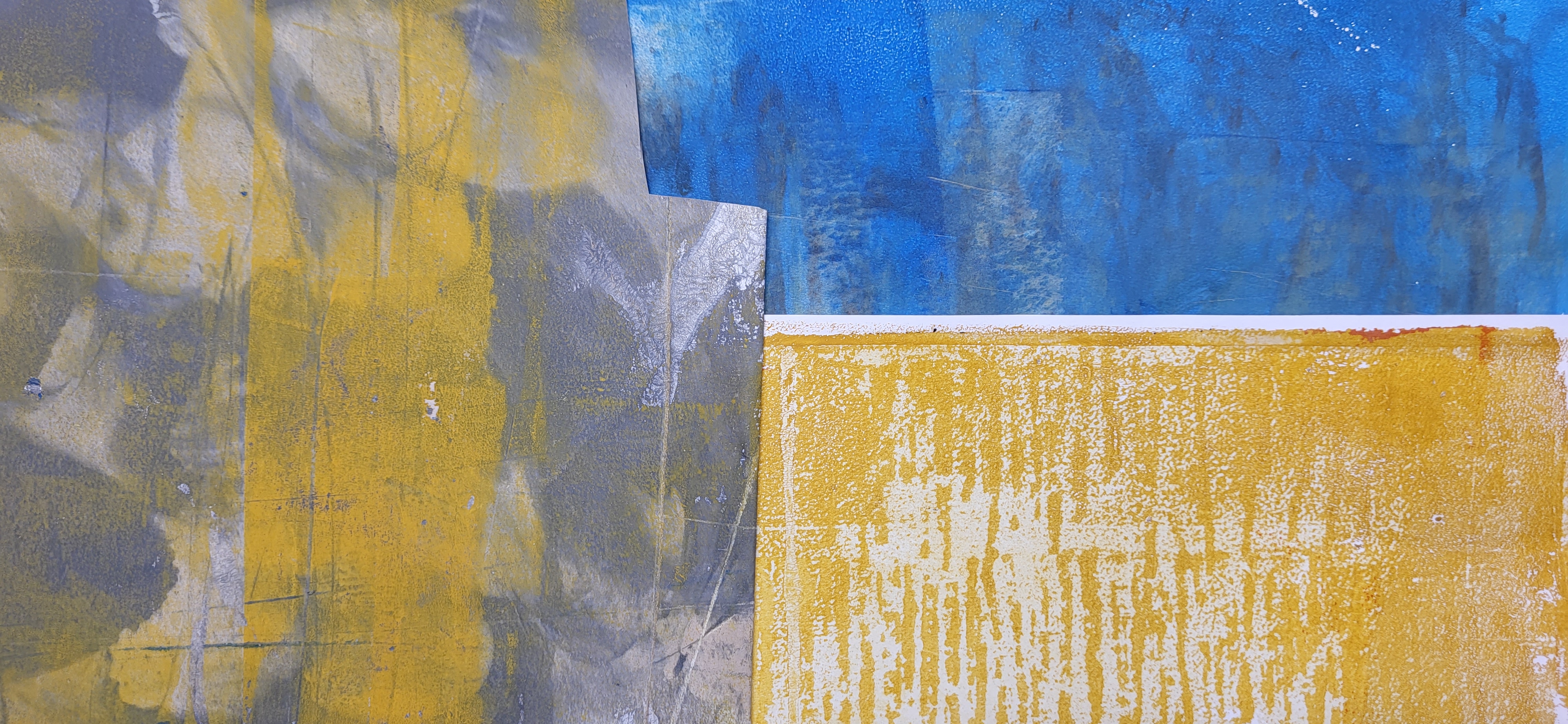
Some of my papers. These were mostly done on a big Gelli plate  with the goal to achieve a weathered look consisting of different layers of paint. The inspiration here were the textures I registered previously. I also used the textured plates to do some rubbings with wax crayons.
For the designing task I wanted to use copies of the papers, however I wasn't very happy with how my printer printed these. I ended up by using the originals


Saturday, 12 August 2023

Diploma Module 1 Chapter 6 second dyeing session

 The goal in this dyeing session was to achieve that dirty kind of yellow of my colour scheme.

I started by mixing a strong mixture of golden yellow and black to use for mixing with the approx 250 ml of soda ash/salt solution.

Here's the yellow resulting fabric with the pure yellow used. Again the photograph doesn't render the true colour. The real colour is more yellow but a bit pale because I diluted it to much. 


I then made a mixture of 5 tablespoons of yellow to 1 tablespoon of black. As expected the resulting fabric was green, I should have known this from the start but it was worth the try


The next mixture was done with equal parts yellow and black. The resulting fabrics turned out to be more of a blueish grey. It was interesting to see that the linen fabrics or with more linen content turned out to look "greyer" than the coton ones.


Just for fun I made a badge of fabric with 3 tablespoons of black and after 20 minutes I added some walnut brown, also Procion but a special mixture by Hilary Beattie. The result is quite nice but  not really fitting into my colour scheme


Conclusion
The goal to dye a dirty mustardy yellow wasn't reached. I have to find another method.

In terms of dyeing grey, it seems to be very difficult even if diluting the black. the greys achieved by mixing brown with a bit of cobalt blue were more successful.
Here eco dyeing might help, I remember having dyed grey fabric with artichokes and they were really grey. 
I will probably try to overdye yellow in the dirty pot.

Fabrics dyed with staghorn, no vinegar or rust added. The sheer silk organza (1st one) took the colour best


Different silks and wools dyed with Saphire blue acid dye


Friday, 11 August 2023

Diploma Module 1 Chapter 6 Colouring materials


This is the colour scheme I chose for this Module, it's  not the easiest to work with and rust and turquoise would probably have been the obvious choice, especially for my theme, but I had already chosen these 2 colours for one of my Certificate modules, I decided to challenge myself.


 I first was tempted to use transfer paints for my colouring method, but they are hard to find here and due to taxes it has become to expensive to order in the UK. I have some paints here and will certainly experiment with them because working with synthetics will give me more options further in the module.

My first step was to go through my existing stash to see if I could find fabrics I could overdye. 

Blue

This is more of a primary Cyan blue, but I hoped that I could achieve a similar colour by overdying  fabric my mixing Cobald blue and midnight blue. I failed (although this is not visible on the pictures below, sorry the camera somehow altered the colours)Of course this blue might work, but it's not the blue I was aiming for. I'm conscious that stitching over the fabrics with the "right" blue might create the effect I wanted. But I will probably try to get a Procion blue that will work. 


 Beige

I still a little bit of a Procion colour called "ecru" left which I wanted to use to dye the light beige of my colour scheme


The result was satisfying only that I probably won't be able to reproduce the colour as I don't have any dye left, another option has to be found.

Grey

To get the grey I wanted I did little experiment, I mixed warm brown with a little bit of cobalt blue. The resulting colour is very pleasing, although with a light greenish tint. For both of the three colours I used the plastic bag method, the fabrics used were coton, poplin and lightweight as well as a  bit of printed commercial fabric.


The I remembered my eco dying experiments from the previous two years.

These are mainly silks but also some linen and coton. These are the colours that come closest to my colour scheme, only that I probably won't be able to reproduce the same except maybe for the grey which can be dyed in the dirty pot with some rust in it.