Wednesday, 28 August 2019

Module 5 - Resolved sample


I finally finished my piece for this module. As Siân suggested I made it longer by adding a piece of scrim I had hand pleated. It was just what it needed. In those pleats I inserted the same silk ribbon strips I had used before, leaving the ends lose. It was in fact difficult to decide how to make the end. I also added a little piece with a flat texture that would wrap around the spool.

I wanted to make a long piece that should reproduce some kind of bandage on a spool with reference to the idea of nature mending/healing itself. The fabric used is rusted scrim. I deliberately chose only one kind of fabric as I didn’t want the piece to be too busy. The strip is composed of different patches all sewn separately on a piece of lightweight cotton that was dyed in black tea with rusty objects. Those pieces were then sewn together with a stitch that tried to reproduce a mending stitch. I also added more stitches in the background to add more texture but also to link the pieces together. The threads used here were a fine Japanese knitting cotton/linen thread that split when stitched thus adding to the “rustic” feel of the piece, as well as a simple DMC embroidery floss in a rusty colour.

I decided to concentrate on pattern using circles (spirals) and strips, varying them in texture and size. To reproduce the strips for instance I applied wrapped pipe cleaners or the silk yarn bits. The pleats were made with the same idea in mind. The different patches are based on the paper samples and the according textile samples. However, I also went with the flow and was open to adapt the patches so that they would fit and add to the movement in pattern of the piece.

The whole piece has a very soft touch and it was a pleasure to handle it.
The spool was made out of 2 layers of Polymer clay that had been painted and rusted. In fact I couldn’t find a rusty spool here so I had to make one myself.


I put my heart and my soul in this piece and I really love the result. I think there’s nothing I would have done differently. Although I had spent many hours hand stitching, I never got bored (and I get bored very easily one I know the outcome of piece). I can truly say that I grew with this piece and that I can identify myself with it.


Sunday, 16 June 2019

Module 5-Chapter 11 Design from Landscape - Divisions

For my finished piece I was inspired by a sentence found in a beautiful book on the area where I took my pictures,  At some stage the author said that nature "healed itself". In fact the area and the surrounding woods were laboured quite intensively some time ago when they extracted iron ore. This has changed the landscape and also the vegetation.

So I decided to make a long strip representing a (medical) bandage on a bobbin.

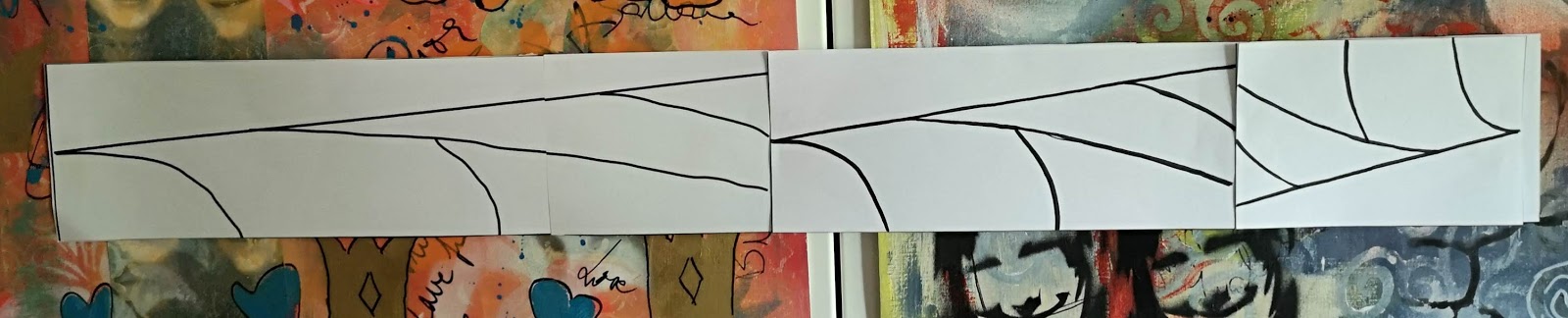
The design obviously had to fit the subject. I wanted the width to be about 10 cm. It would be difficult to make something narrower. For the length I was thinking of the Fibonacci sequence, as suggested by Siân. The strip should be about 80 cm to allow for divisions into 40, 25 and 15 cm.

I made a bobbin out of polymer clay as I couldn't find one with the right measurements and made a mock-up


Then I looked at the different designs that could be translated into a strip


I finally decided to contentrate on 2 designs and tried to translate it into a long strip


Design 1a and b

Design 2a
as you can see I had turned the last smaller part upside down. This gave me the idea to change the directions of the different parts
I found that this design had a much nicer "flow", the different sections are larger and it would be easier to translate them into fabric.

This is the final design I'd like to use. I connected the different pieces to make one long harmonious strip.

And finally I finished my bobbin
I wanted it to look like an old rusted spool. For this I made a base with white polymer clay as you can see in the mock-up from before. This was then covered with  brown clay lightly textured, painted with Golden iron oxyde then rusted. The spool was baked after each section of work.
I'm quite happy with the result and think that it doesn't look at all like polymer clay anymore.


Module 5-Chapter 11 Design from Landscape- Landscapes part 1

I went back into the woods to take some more pictures that could lead to a "landscape translation"
Some designs are far too complex and would have to be simplified to become appropriate to the subject and to be translated into fabric


Sunday, 26 May 2019

Module 5 - Chapter 11 - Design from Landscape


 I started to rust different fabrics ranging from synthetic ones to coton ones. As I didn't have rusty items I had to make them produce rust. As most of the metal items you find in the hardware store are treated not to rust I first had to remove this by putting the metal into hydrochloric acid, I agree it's not an eco-friendly method but a fast and efficient one.

I went back into the woods to take more  landscape pictures but also to reconnect to my subject.

The following are just simple as I'm not sure if I'm going in the right direction