Sunday, 16 March 2014

Module 3 - Chapter 7 - Toggles with meltable materials - Part 1


These beads are fun to make and give room to experimenting

Toggle a is made with two layers in orange and blue painted Tyvek wrapped with coton thread and then zapped

Toggle b has also been made with painted Tyvek, however the basic shape of the rolled material is a rectangle. This bead was painted partially to add a bit or "zing" to it.

Toggle c: here I rolled Tyvek with a thick tubular embroydery thread and blue embroidery thread. Because of the thicker orange thread, the shape of the bead is changed.

Toggle d: The material used here is a blue polyester organza wrapped with copper metallic machine thread

Toggle e: the material used here is acrylic felt painted with blue acrylic paint and wrapped with a copper wire. The melting changed the colour and now it is more of a green that a blue. Of course it could be painted at a later stage

Toggle f: this bead is made of layers of cling wrap and blue polyester organza.

Toggle g is also made of cling wrap alternating wrap and layers of blue embroidery thread. The final orange ribbon used for the wrapping could also be melted.


Toggles h and i: these polyester beads were wrapped with a pipe cleaners in orange and blue. These also melt back to a hard material which could be painted at a later stage


Module 3 - Chapter 7 - Wrapped buttons


All of these buttons have a core made of Kapa board. This material has the advantage that it is not too thick and can be cut to any shape desired. The one I used has a glue side which helps to fix the wrapping fabric on one side. It also allows you to fix the fabric on the back with tiny needles.


Button a is a rectangle wrapped with blue and orange fabric and decorated with a polymer clay bead.

Button b has a half-moon shape which was a bit trickier to wrap. I used an orange dyed pre-felt as the wrapping fabric


Button c: a rectangle wrapped with an orange cotton fabric and a polyester organza on top. This was melted with a heating gun.


Button d is wrapped with orange pre-feld, a commercial fabrick strip and yarn. It is decorated with a polymer clay spiral

Button e has a leaf shape. It is wrapped with the piece of an old sweater and decorated with beads


Button f has a circular shape wrapped with blue pre-felt and embroidery thread and knitting yarn
.


Button g: the core of this one is a plastic curtain ring wrapped with an orange polyester ribbon and embroidery thread

Button h is made of cling film wrapped with various threads and decorated with beads


Button i: the core of this button/toggle consists of a rolled piece of pre-felt wrapped with a light-coloured tight, wrapped with various threads a stringed beads


The core of the following button is made of aluminium foil. The idea was to form a spike which could be fixed to a piece of work. On button k you might be able to see that I inserted a wire "hook".

Button j is wrapped with  blue fabric and a piece of tight rubbed with orange paint.

Button k is wrapped with blue polyester organza

Sunday, 2 March 2014

Module 3-Chapter 7 DORSET BUTTONS

 This is my first try at Dorset buttons. I had found plastic rings and had a go, using different threads and contrasting colors. My greatest difficulty was to center the spokes and I certainly will have to practice a bit more. Button number 3 was one of those were the center "wasn't in the center" so I tried to make a tree out of it. Also with this sample I had tried to make my own ring with wire. Covering it with button hole stitch was tricky as the wire was too slippery.


Here I covered the outer ring and the center with little beads


A giant button and also my favourite. The ring is made with thicker wire. The I used fabric painted fabric strips for the weaving, the spokes are wrapped with orange wool thread.


Further rings are waiting to be turned into dorset buttons

And another one

number 6

One of the thicker curtain rings was wrapped, the center is made out of tubular nylon knitting yarn


Sunday, 9 February 2014

Module 3 - Chapter 5

C. Knotted, Plaited and Wrapped Methods

Knotted Method


 Close-ups of C4 and C3


Close-up of lower part of  C5


Close-up of C6


Making of a Turks knot on a ring mandrel


Wrapped Methods


 Close-up of d3


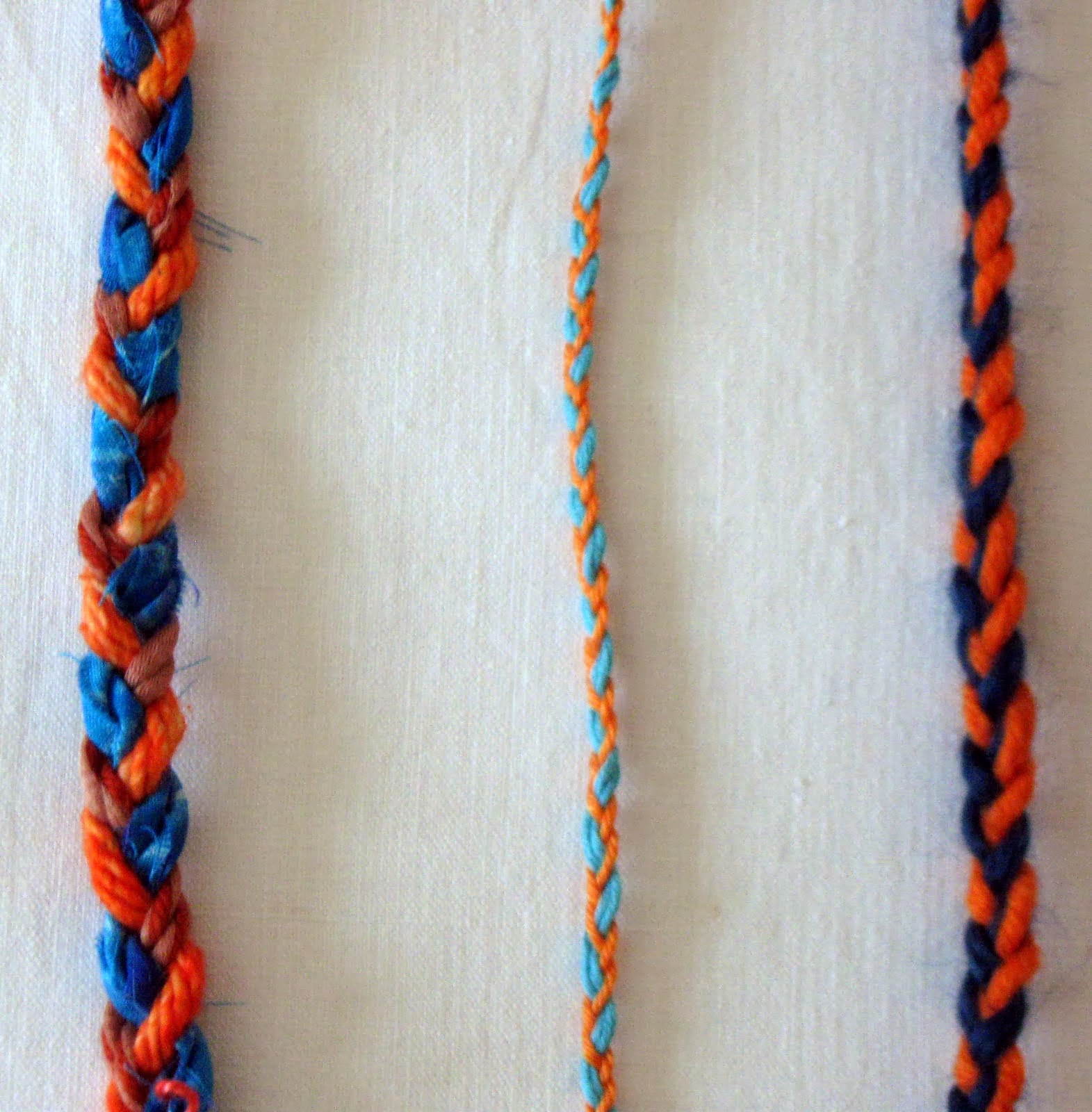
Plaited Method


From left to right: 
- plaited cord made with two twisted cords and one thicker thread
- two cords the same and one contrast
- same than above with thicker knitting thread